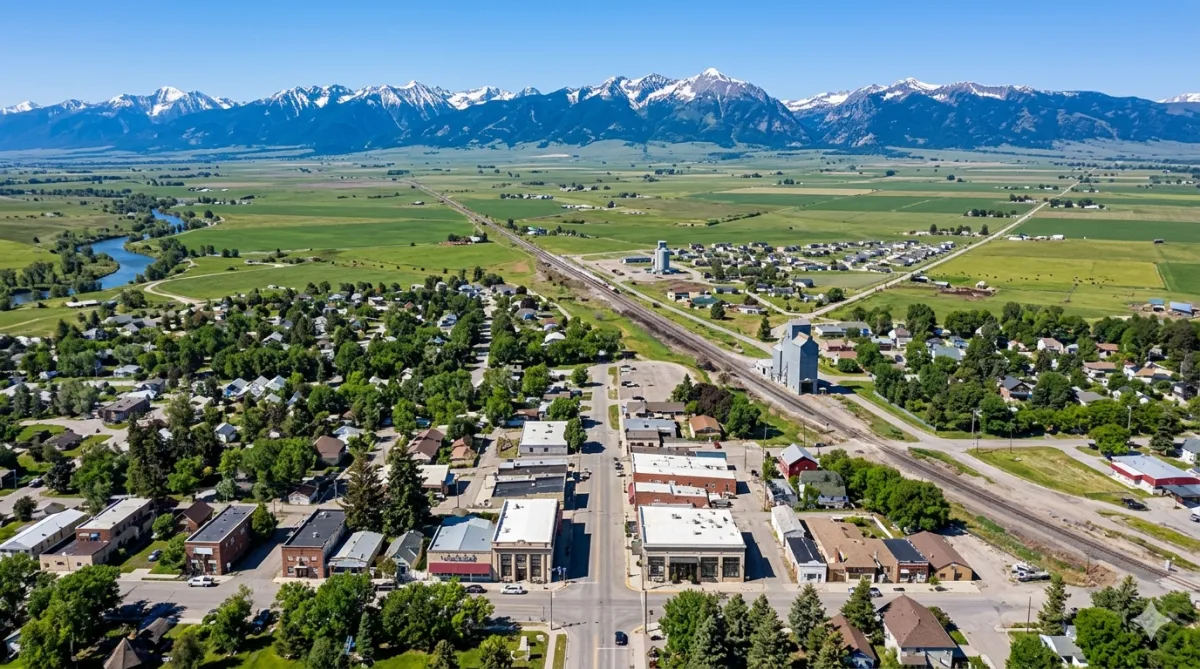
What Makes Manhattan, Montana Different from Other Valley Towns?
What Makes Manhattan, Montana Different from Other Valley Towns?
A closer look at the Gallatin Valley town that keeps showing up on relocation shortlists.
Every Gallatin Valley buyer asks this question eventually: why not just buy in Bozeman? The honest answer, for buyers watching their budget, is that Manhattan offers something Bozeman's growth has quietly priced out. This guide covers what Manhattan actually delivers, what it does not, and who fits best here.
The short answer:Manhattan sits about 25 minutes west of Bozeman, close enough for the airport and groceries but far enough to feel like its own place. The school district has ranked in the top 10% statewide in recent years, the median home price runs well below Bozeman's, and the town's population has held steady near 2,000 for years. For buyers who want Gallatin Valley access without Gallatin Valley pricing, Manhattan belongs on the shortlist.
Nancy Clark has sold homes in Manhattan, Montana for more than a decade. As Broker and Owner of AmeriMont Broker Group, and a Manhattan resident herself, she knows this town the way only someone who lives there can.
How Far Is Manhattan from Bozeman, and Does the CommuteMatter?
Manhattan is roughly 25 miles west of Bozeman along Interstate 90, which puts most drives at 20 to 30 minutes depending on the time of day and weather. In summer, that drive is one of the more scenic stretches of highway in the Gallatin Valley, with the Bridger Mountains to the north and open farmland on both sides.
The commute question comes up in nearly every conversation with buyers who are comparing Manhattan to Bozeman or Belgrade. The honest answer is that 25 minutes feels like nothing if you are coming from a metro area with 45-minute commutes in traffic. It feels like more if you are used to a five-minute drive across town.
What makes the commute easier than it looks on paper: I-90 between Manhattan and Bozeman rarely has the stop-and-go congestion you see in larger markets. Morning traffic into Bozeman picks up around the Four Corners interchange, but Manhattan's on-ramp sits west of most of that.
What makes it harder: winter mornings. The stretch between Manhattan and Belgrade can ice up, and there are a few weeks each year where the drive takes 35 to 40 minutes because road conditions slow everything down. That is not a dealbreaker for most buyers, but it is worth knowing before you commit.
For Bozeman Yellowstone International Airport, Manhattan is actually closer than several Bozeman neighborhoods. The airport sits between Belgrade and Bozeman, and Manhattan's proximity to Belgrade puts it within about 15 minutes of the terminal.
What Do Homes Cost in Manhattan Compared to Bozeman?
Manhattan's median home prices run significantly below Bozeman's, often by $100,000 to $200,000 or more depending on the type of property. As of spring 2026, Montana's statewide median home price sits around $475,000 to $506,000, depending on the data source. Manhattan generally falls below that statewide number for comparable homes.
The price difference is one of the first things out-of-state buyers notice. A three-bedroom home on a half-acre lot in Manhattan might list for what a two-bedroom condo lists for near downtown Bozeman.
That said, Manhattan's market is not uniform. Properties with acreage, especially parcels of five acres or more, can push into higher price ranges quickly. Condos and smaller lots in the town core tend to be the most accessible price points. Verify current pricing by searching active listings onnancyclarkbroker.comor checking the Gallatin Association of Realtors MLS data, as market conditions shift month to month.
The real value proposition is not just the lower price tag. It is what you get for the money. In Manhattan, the same budget that buys a compact lot in Bozeman often buys more land, more privacy, and a shorter drive to open country.
What Are the Schools Like in Manhattan?
Manhattan's school district is one of the strongest in the state, and for many families, this is the deciding factor. Manhattan School District ranks in the top 10% of all 333 school districts in Montana based on combined math and reading proficiency data. Manhattan High School ranks in the top 5% statewide, with a graduation rate of 95%.
Manhattan Elementary serves grades PreK through 5, with approximately 259 students enrolled. Manhattan High School serves grades 9 through 12, with roughly 241 students. Those are small numbers by any standard, and that is part of the draw.
In a school with 241 high schoolers, teachers know students by name. The ratio of adults to kids at school events is high. Sports teams, theater programs, and academic clubs are accessible to any student who wants to participate, not just the top recruits. Parents who grew up in larger districts notice this right away.
The tradeoff: a smaller district means fewer course offerings, fewer extracurricular options, and less competition in some academic tracks. Students who need specialized programs or highly competitive athletics may find the options limited compared to Bozeman's larger high schools. But for buyers who value close-knit academic environments, Manhattan's numbers speak clearly.
What Kind ofCommunity Does Manhattan Actually Have?
Manhattan is an agricultural town that has not tried to become something it is not. The main street has a few local restaurants, a hardware store, and the kind of businesses that survive because the people who run them are also the people who live there. There is no chain-store corridor, no resort marketing, no weekend-tourist economy propping up the tax base.
The town hosts a potato festival every year. That might sound quaint, but it tells you something real about the character of the place. Manhattan's identity is rooted in farming, ranching, and the families who have been here for generations. Newer residents tend to be people who wanted that kind of town on purpose, not people who ended up there by accident.
The community feel shows up most at school events, local sports, and the churches that anchor a lot of the town's social life. Manhattan is the kind of place where your kids' friends' parents are also your neighbors, and where coaches are volunteering because they care about the program.
Manhattan also offers something Bozeman increasingly does not: a pace of life that has not sped up. The growth pressures that have reshaped Bozeman's west side and Belgrade's northern corridor have not hit Manhattan in the same way. The town's population has held steady near 2,058 by recent Census Bureau estimates, and that stability is not an accident. It reflects a community that values what it already is.
What Does Manhattan Offer Buyers?
Manhattan offers a tight-knit community with strong schools at prices well below Bozeman's, without the walkable urban amenities of a bigger town. Five things come up most often with buyers: the schools, the price advantage, the pace, VA loan fit, and remote-work practicality.
Small class sizes and a tight-knit school community. The district trades the breadth of a larger system for close-knit academics. Its top-10% ranking in recent years is not marketing language. It reflects real academic performance in a district small enough that every student matters.
A price advantage within the valley. Manhattan's lower price points mean a move here from a higher-priced market like Bozeman often frees up meaningful capital without leaving the valley.
A smaller, slower, more grounded pace. Manhattan fits the classic picture of Montana life better than Bozeman does in 2026. Bozeman has grown into a small city with corresponding traffic, pricing, and density. Manhattan has not.
VA loan fit. Manhattan's price points tend to align well with VA loan limits, and the community has a genuine respect for service that shows up in how neighbors treat each other.
Remote-work practicality. Reliable internet is available in Manhattan's core, though speeds can vary on rural parcels outside town. The 25-minute drive to Bozeman is an easy once-or-twice-a-week trip for hybrid schedules.
What Should BuyersThink CarefullyAbout Before Choosing Manhattan?
Manhattan's lower prices and small-town character come with real tradeoffs that buyers should weigh honestly before committing. Limited walkable amenities, a smaller school district, winter commute conditions, slower resale timelines, and variable rural internet are the factors that most often surprise buyers who did not plan for them.
If you need walkable urban amenities, Manhattan will not deliver. There is no coffee shop on every corner, no late-night dining, no yoga studio within walking distance. Bozeman is 25 minutes away for those things, and that distance adds up if you want them daily.
If your kids need specialized academic programs, the smaller district may not offer what a larger Bozeman or Belgrade school can. Gifted programs, advanced placement course variety, and competitive athletics are more limited. Families with specific educational needs should visit the district before deciding.
If you work in Bozeman five days a week, the winter commute deserves honest consideration. Twenty-five minutes in July is different from forty minutes in January on an icy road. Most Manhattan commuters make it work, but it requires comfort with winter driving and flexibility on the worst weather days.
If you want strong resale liquidity, be aware that Manhattan's market moves more slowly than Bozeman's. Fewer buyers at any given time means homes can sit longer, and pricing trends do not always follow Bozeman's trajectory. That is not a reason to avoid Manhattan, but it is a reason to think about your timeline if you might sell within three to five years.
If you need high-speed internet on a rural parcel, verify coverage before making an offer. In-town properties typically have decent broadband options, but parcels outside the town boundary may rely on satellite or fixed wireless, which can be limiting for heavy data users or video-dependent remote work.
A Common Situation
Consider a family relocating from Portland, Oregon. Both parents work remotely. They have two kids, ages 8 and 11, and they have budgeted around $475,000 for a home with some space.
In Bozeman, that budget puts them in a three-bedroom home on a small lot in a newer subdivision on the city's edge, with traffic noise from the arterial road and an HOA that restricts outbuildings. In Manhattan, the same budget opens up options on half-acre or larger lots, with a garage, a yard the kids can actually use, and neighbors who wave when they drive by.
The tradeoff is the commute to Bozeman for groceries, the occasional need to drive 25 minutes for a dinner out, and a smaller school that may not have the specific extracurricular their older child wants. But for a family that moved to Montana specifically to slow down, those tradeoffs often feel like features, not compromises.
Quick Comparison: Manhattan vs. Bozeman vs. Belgrade
FactorManhattanBozemanBelgradeDrive to Bozeman~25 min—~12 minDrive to Airport~15 min~12 min~5 minMedian Home Price (approx.)Below statewide medianAbove statewide medianNear statewide medianSchool District RankingTop 10% statewideVaries by schoolVaries by schoolPopulation (2026)~2,058~56,000+~12,000+Community CharacterAgricultural small townCollege town, small cityFast-growing suburbWalkable AmenitiesLimitedStrongModerateGrowth PaceStableRapidRapid
Price data reflects general market positioning as of spring 2026. Verify current pricing with a local broker for the most accurate comparison.
The Bottom Line
Manhattan is not trying to be the next Bozeman, and that is precisely what makes it worth a serious look. For buyers who want top-tier schools without top-tier pricing, valley access without Bozeman rates, or the slower pace that drew them to Montana, Manhattan delivers on the promise that Bozeman's marketing still makes but its growth has outpaced.
The buyers who end up happiest here are the ones who visited, drove the streets, talked to a neighbor, and decided the tradeoffs were worth it. That kind of buyer tends to stay.
Next Steps
If Manhattan is on your shortlist, here is where to go from here.
Search current listings. Visit nancyclarkbroker.com for active Manhattan properties across all price points.
Schedule a drive-through. Not a showing, just a drive. Spend an afternoon in Manhattan. Stop at a local spot, drive the residential streets, check the commute to Bozeman at the time of day you would actually make it.
Talk to someone who lives there. Nancy Clark is a Manhattan resident and Broker/Owner of AmeriMont Broker Group. Reach her at [email protected] to ask the questions this article did not answer.
FAQ
How far is Manhattan, Montana from Bozeman?
Manhattan is roughly 25 miles west of Bozeman along Interstate 90. The drive takes 20 to 30 minutes in normal conditions, slightly longer in winter weather. The airport is even closer, about 15 minutes from Manhattan.
What are property taxes like in Manhattan, Montana?
Property taxes in Gallatin County are based on the assessed value of your home and the local mill levy rates. Manhattan's rates are generally comparable to other Gallatin Valley communities, though specific amounts vary by property. Check with theGallatin County Treasurer's officefor current rates and payment schedules.
What are Manhattan's schools like?
Manhattan's school district has ranked in the top 10% statewide in recent years, with a roughly 95% high school graduation rate and small class sizes where teachers know every student. The tradeoff is fewer extracurricular options compared to larger districts in Bozeman.
What is the population of Manhattan, Montana?
Manhattan's 2026 population is approximately 2,058, holding relatively steady from the 2020 census count of 2,086. The town has not experienced the rapid growth that has reshaped Bozeman and Belgrade over the past several years.
Can you commute from Manhattan to Big Sky for work?
The drive from Manhattan to Big Sky runs about 55 to 65 minutes, depending on the route and season. It is a longer commute than Bozeman to Big Sky, and winter conditions on Highway 191 through the Gallatin Canyon add time and risk. Daily commuting is possible but demanding.
Are there restaurants and shops in Manhattan?
Manhattan has a small selection of local restaurants, a grocery store, and essential services. For a wider range of dining, shopping, and entertainment, Bozeman is a 25-minute drive. Most Manhattan residents plan weekly or biweekly trips to Bozeman for larger errands.
What internet options are available in Manhattan?
Properties within Manhattan's town limits generally have access to cable or DSL broadband from regional providers. Rural parcels outside town may be limited to satellite or fixed wireless options. If reliable high-speed internet is critical for your work, verify coverage on the specific property before making an offer.
Is Manhattan, Montana growing too fast?
No. Manhattan's population has been essentially stable for the past several years, hovering near 2,058. Unlike Bozeman and Belgrade, which have seen rapid residential and commercial development, Manhattan has not experienced a comparable building boom. That stability is one of the reasons buyers choose it.
Nancy Clark
Broker/Owner, AmeriMont Broker Group
Manhattan, Montana[email protected]
nancyclarkbroker.com
Nancy Clark is the Broker and Owner of AmeriMont Broker Group, serving Manhattan, Amsterdam, Churchill, and communities across southwest Montana. With more than $135 million in closed sales and over a decade of experience in Montana real estate, Nancy brings the care of a neighbor and the skill of a seasoned professional to every transaction. Reach her at [email protected] or visit nancyclarkbroker.com.


